Boost Traffic Optimize Rank Convert SEO Strategy
- Get link
- X
- Other Apps
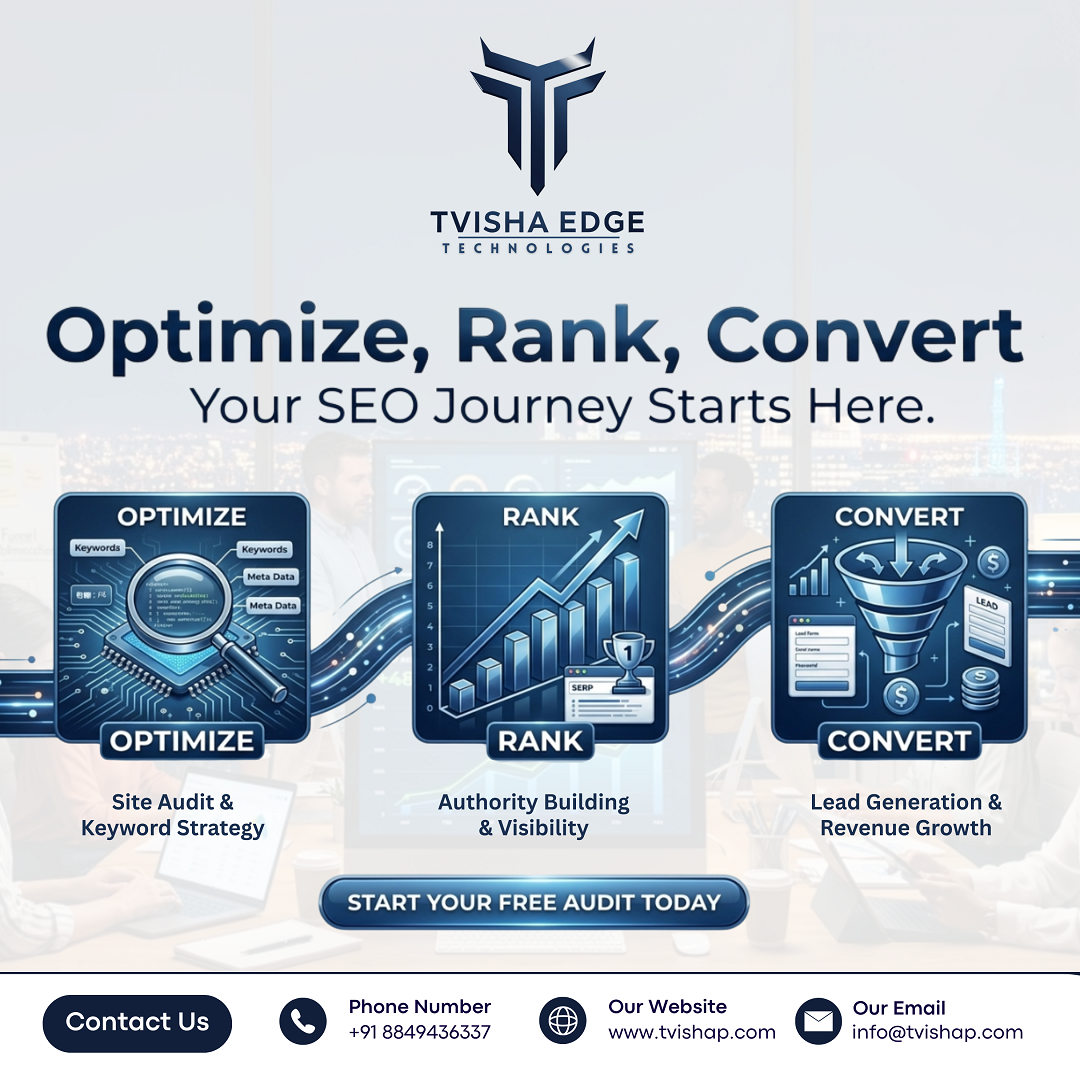
Boost Conversions with Powerful SEO Strategy by Tvisha Edge Technologies
Boost Traffic Optimize Rank Convert SEO Strategy is often discussed in abstract terms—keywords, backlinks, and rankings—but in real-world operations, especially for businesses running warehouses, factories, or industrial services, SEO must translate into measurable outcomes such as consistent traffic, qualified leads, and conversions that justify the effort.
This blog breaks down SEO as it is actually applied in practice—not as a simple checklist of tactics, but as a structured approach aligned with business goals, user intent, and real operational constraints.
Understanding SEO Beyond Rankings
Many teams focus heavily on ranking positions without aligning SEO with business outcomes. In industrial environments, where buying cycles are longer and decision-makers are more analytical, ranking alone doesn’t guarantee results.
A practical SEO strategy must address three layers:
- Traffic – Are the right people visiting your website?
- Relevance – Does the content match user intent?
- Conversion – Are visitors taking meaningful actions?
If any one of these is missing, SEO efforts tend to underperform regardless of rankings.
1. Start with Search Intent, Not Just Keywords
Keyword research is still important, but it should be guided by intent rather than volume alone.
In industrial and B2B contexts, search intent typically falls into:
- Informational: “What is a scissor lift used for?”
- Comparative: “Hydraulic vs electric scissor lift”
- Transactional: “Buy industrial scissor lift supplier”
- Problem-solving: “How to improve warehouse loading efficiency”
Instead of targeting isolated keywords, structure content around real questions your audience is asking during decision-making.
Practical Tip:
Map keywords to stages of the buyer journey:
- Awareness → educational blogs
- Consideration → comparison guides
- Decision → product/service pages
2. Build Content Around Real Operational Challenges
Content performs better when it reflects actual challenges faced in the field.
For example, warehouse managers often deal with:
- Space constraints
- Load handling inefficiencies
- Equipment downtime
- Safety compliance
SEO content should address these issues with practical insights rather than generic explanations.
What Works Better?
- Case-based explanations
- Process-driven content
- Real-world use scenarios
- Equipment selection guidance
This approach builds trust because it demonstrates familiarity with day-to-day operational realities.
To improve your website structure and keyword optimization, you can explore trusted SEO guidance from Yoast.
3. Structure Content for Clarity and Usability
Search engines prioritize content that is easy to understand and navigate.
A well-structured page should include:
- Clear headings and subheadings
- Short, readable paragraphs
- Logical flow of information
- Internal linking to related topics
For industrial audiences, clarity is critical. Decision-makers often skim content before diving deeper.
Practical Tip:
Use headings that reflect actual questions or tasks, such as:
- “How to choose the right equipment”
- “Common mistakes to avoid”
- “Steps for implementation”
4. On-Page SEO: Precision Over Over-Optimization
On-page SEO still matters, but over-optimization can reduce readability and user trust.
Focus on:
- Naturally integrating keywords
- Writing descriptive titles and meta descriptions
- Using meaningful anchor text for internal links
- Optimizing images with relevant alt text
- Avoid keyword stuffing or forcing terms where they don’t fit naturally.
Operational Insight:
- In industrial SEO, clarity and technical accuracy often outperform keyword density.
- To understand competitor strategies and improve rankings, Ahrefs provides powerful SEO insights.
5. Content Depth Matters More Than Content Length Alone
Long-form content can perform well, but only when it provides depth.
Depth means:
- Covering multiple angles of a topic
- Addressing practical concerns
- Including examples and scenarios
- Explaining trade-offs
A 1500-word article without substance will not outperform a concise, well-structured 800-word guide that directly answers user needs.
6. Technical SEO: The Foundation That Supports Everything
Even the best content will struggle if the website has technical issues.
Key areas to monitor:
- Page load speed
- Mobile responsiveness
- Crawlability and indexing
- URL structure
- Broken links
- Duplicate content
Practical Challenges in Industrial Websites:
- Heavy images slowing down pages
- Poor mobile optimization
- Outdated CMS structures
- Lack of proper internal linking
Regular audits help identify and fix these issues before they impact performance.
7. Internal Linking: Guiding Users Through Information
Internal linking is often underutilized but plays a critical role in SEO and user experience.
A strong internal linking strategy:
- Helps users discover related content
- Distributes authority across pages
- Improves crawlability
- Reduces bounce rates
Example:
A blog about warehouse optimization can link to:
- Equipment selection guides
- Case studies
- Service pages
This creates a content ecosystem rather than isolated pages.
8. E-E-A-T: Building Trust Through Content
Google emphasizes Experience, Expertise, Authority, and Trust (E-E-A-T), especially for topics that influence business decisions.
To demonstrate E-E-A-T:
- Share practical insights based on real-world use
- Include technical explanations where relevant
- Avoid vague or generic statements
- Maintain accuracy and transparency
In Industrial Context:
Trust is often built through:
- Case studies
- Real examples
- Clear process explanations
- Industry-specific terminology used correctly
9. Conversion Optimization: Turning Traffic into Leads
Traffic alone is not enough. Conversion optimization ensures that visitors take action.
Key elements include:
- Clear call-to-action (CTA)
- Simple inquiry forms
- Relevant landing pages
- Trust indicators (certifications, experience, projects)
- Easy navigation
Practical Insight:
- In B2B environments, conversions are often not immediate. Providing multiple touchpoints (downloads, inquiries, consultations) increases the likelihood of engagement.
- Ready to grow your business with a result-driven SEO strategy? Contact us today and start improving your traffic, rankings, and conversions.
10. Content Refresh and Maintenance
SEO is not a one-time effort. Content must be updated periodically to remain relevant.
Reasons to refresh content:
- Changes in industry practices
- New technologies or equipment
- Updated regulations
- Shifts in search behavior
Practical Approach:
- Review top-performing pages quarterly
- Update outdated data
- Improve clarity and structure
- Add new sections where needed
11. Measuring SEO Performance the Right Way
Instead of focusing only on rankings, track metrics that reflect business impact:
- Organic traffic quality
- Time on page
- Bounce rate
- Conversion rate
- Lead inquiries
- Pages per session
Operational Insight:
- A drop in rankings does not always indicate failure if conversions remain steady or improve.
12. Common SEO Challenges in Industrial Businesses
Some recurring issues include:
- Limited content resources
- Lack of internal SEO expertise
- Difficulty translating technical knowledge into content
- Slow approval cycles for publishing
- Inconsistent content strategy
Addressing these requires coordination between technical teams, marketing teams, and subject matter experts.
Practical SEO Strategy Framework
A working SEO strategy for industrial or B2B businesses typically follows this flow:
- Identify target audience and their search behavior
- Map keywords to intent and buyer journey stages
- Create structured, problem-focused content
- Optimize technical foundation of the website
- Implement internal linking and content clustering
- Monitor performance and refine continuously
- Align SEO outcomes with business goals (leads, inquiries, conversions)
About Industry Implementation
Organizations like Tvisha Edge Technologies focus on practical digital strategies tailored for industrial and technical businesses. Their approach typically involves aligning SEO efforts with operational realities, ensuring that content, structure, and optimization are not just theoretically sound but also usable for real-world decision-making. For more details, visit: https://tvishap.com/
Conclusion:
SEO is most effective when treated as an ongoing operational process rather than a one-time marketing activity. In industrial contexts, success depends on understanding user intent, addressing real challenges, maintaining technical stability, and continuously improving content based on performance data.
A balanced approach—combining content quality, technical reliability, and user-focused design—creates a system where traffic, rankings, and conversions grow together over time.
Get in touch with our SEO experts now to build a powerful, performance-focused digital strategy for long-term growth.
Trending FAQs
Q1: How long does it take to see SEO results?
- SEO timelines vary depending on competition, website authority, and content quality. Typically, noticeable improvements take a few months, with more stable results developing over time through consistent effort.
Q2: Is keyword density still important for SEO?
- Keyword density is less important than relevance and readability. Search engines prioritize content that naturally addresses user intent without forced keyword usage.
Q3: What type of content works best for industrial SEO?
- Content that solves real operational problems, provides comparisons, explains processes, and reflects industry-specific scenarios tends to perform best.
Q4: How often should SEO content be updated?
- High-performing pages should be reviewed at least every few months, while less critical content can be updated annually or when significant changes occur.
Q5: Can small industrial businesses compete with larger companies in SEO?
- Yes, by focusing on niche topics, long-tail keywords, and highly specific operational content, smaller businesses can compete effectively in targeted areas.
#SEO #DigitalStrategy #IndustrialMarketing #ContentMarketing #B2BSEO #SearchOptimization #OrganicTraffic #LeadGeneration #TechnicalSEO #TvishaEdgeTechnologies #AhmedabadBusiness #SEOStrategy #BusinessGrowth
- Get link
- X
- Other Apps


Comments
Post a Comment