Grow Better Businesses with Smart Email Marketing
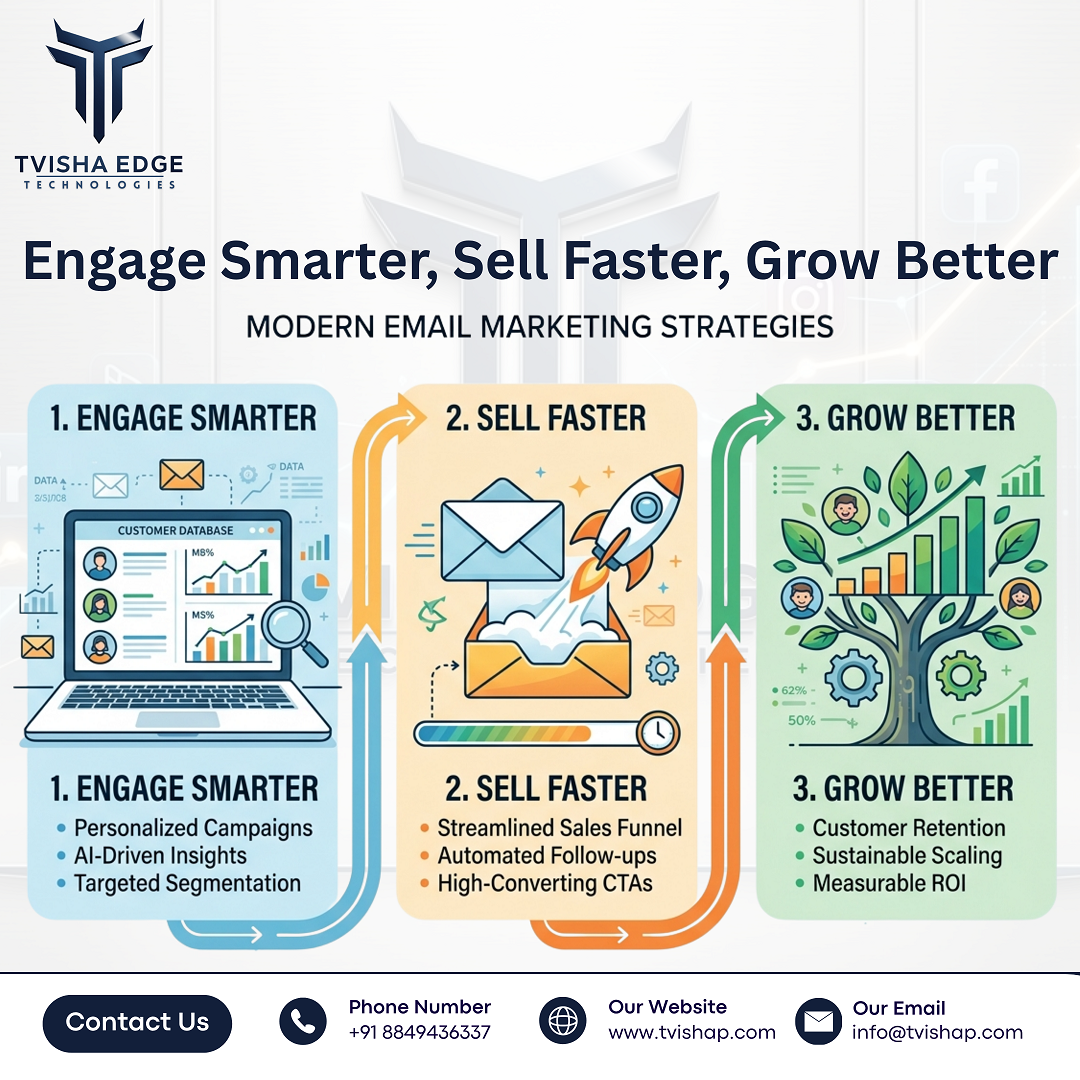
Grow Better Businesses with Smart Email Marketing: Powered by Tvisha Edge Technologies for Maximum Engagement and Growth
Grow Better Businesses with Smart Email Marketing is becoming an essential strategy for organizations that depend on consistent communication with customers, partners, and qualified leads. Email marketing continues to be one of the most practical and controllable channels for businesses operating in manufacturing, warehousing, industrial services, and B2B environments, where success is driven more by relationships and long-term engagement than instant conversions.
For such industries, email is not just a tool for quick sales—it plays a crucial role in maintaining strong customer relationships, encouraging repeat business, and supporting extended sales cycles. When used strategically, it helps businesses stay connected and relevant throughout the entire customer journey.
Smart email marketing is not defined by volume or automation alone. It is driven by relevance, timing, data accuracy, and alignment with real operational needs. When implemented correctly, it becomes a structured system that supports sales teams, reduces communication gaps, and improves visibility across every stage of the customer lifecycle.
This blog explores how businesses can adopt email marketing in a practical and results-oriented way—without unnecessary complexity or unrealistic expectations.
Understanding the Role of Email Marketing in Real Business Operations
In many industrial and service-based organizations, email marketing is often misunderstood as a promotional tool alone. In reality, it plays multiple roles:
- Maintaining communication with existing clients
- Supporting lead nurturing over long sales cycles
- Sharing updates about products, services, or processes
- Reducing dependency on manual follow-ups
- Documenting communication history for internal teams
For example, a manufacturing company may use email to inform clients about production updates, delivery timelines, or new product specifications. Similarly, a logistics or warehousing business may use email to update clients about inventory status or service availability.
The effectiveness of email marketing in such environments depends heavily on structure and consistency rather than creative campaigns.
Building a Reliable Email Foundation
Before focusing on campaigns or automation, businesses must ensure that their email foundation is stable. This includes data quality, segmentation, and consent.
1. Clean and Verified Contact Data
Incomplete or outdated contact lists lead to low engagement and deliverability issues. Businesses should periodically:
- Remove inactive or bounced emails
- Verify contact details from CRM systems
- Avoid importing unqualified or irrelevant leads
2. Segmentation Based on Business Logic
Segmentation should reflect real-world categories, such as:
- Existing customers vs. prospects
- Industry type
- Purchase history or service usage
- Geographic region
- Role (procurement, operations, management)
This ensures that messages are relevant to the recipient’s context rather than generic.
3. Permission and Compliance
Maintaining consent is not just a legal requirement but also a trust factor. Businesses should:
- Collect opt-ins through forms or interactions
- Avoid unsolicited bulk emailing
- Provide clear unsubscribe options
- Creating Emails That Serve a Purpose
Smart email marketing focuses on clarity and utility rather than persuasion-heavy messaging.
Keep Content Relevant and Action-Oriented
Each email should answer a specific need:
- Is it informing?
- Is it updating?
- Is it guiding a next step?
For industrial or B2B audiences, overly promotional content often performs poorly. Instead, practical information such as specifications, updates, or process explanations tends to be more effective.
Structure Matters
A well-structured email typically includes:
- A clear subject line reflecting the content
- A concise introduction
- A focused body with essential information
- A simple call to action (if required)
Avoid unnecessary length. Decision-makers often scan emails rather than read them in detail.
Automation That Reflects Real Workflows
Automation should mirror actual business processes rather than forcing artificial funnels.
Common Use Cases:
- Lead nurturing sequences for new inquiries
- Order or service updates
- Onboarding emails for new clients
- Periodic check-ins for existing accounts
For more creative business insights and marketing ideas, explore Tumblr.
com and contact us to implement a smart and effective email marketing strategy for your business.
Internal coordination notifications
For example, a new inquiry submitted through a website can trigger a sequence:
Acknowledgment email
- Follow-up with relevant service details
- Optional case study or documentation
- Reminder if no response is received
The goal is not to overwhelm the recipient but to maintain continuity in communication.
Aligning Email Marketing with Sales Teams
Email marketing should not operate in isolation. It should support sales and operations teams.
Integration with CRM Systems
A CRM system helps track:
- Lead status
- Email interactions
- Communication history
- Customer lifecycle stage
This ensures that both marketing and sales teams have a unified view of each contact.
Reducing Manual Follow-Ups
Well-designed email workflows can reduce repetitive manual tasks. For instance:
- Automated reminders for pending quotations
- Scheduled updates for ongoing projects
- Notifications for internal teams when a lead responds
- This improves efficiency and reduces dependency on individual effort.
For more insights on global business and marketing trends, visit Forbes.com and contact us to build a smart and effective email marketing strategy for your business.
Measuring What Actually Matters
Many businesses track vanity metrics such as open rates without connecting them to outcomes. While metrics are important, they should reflect business objectives.
Key Practical Metrics:
- Response rate from recipients
- Conversion from inquiry to qualified lead
- Engagement with specific types of content
- Repeat communication from existing clients
- Reduction in manual follow-ups
Instead of focusing solely on email clicks, evaluate whether emails contribute to smoother operations and better communication flow.
Common Challenges in Email Marketing
1. Low Engagement
- Cause: Irrelevant content or poor segmentation
- Solution: Refine audience grouping and ensure emails are context-specific
2. Deliverability Issues
- Cause: Poor list hygiene or spam-like patterns
- Solution: Maintain clean lists and avoid excessive promotional language
3. Lack of Consistency
- Cause: Irregular sending or lack of process
- Solution: Establish a schedule aligned with business cycles
4. Over-Automation
- Cause: Complex workflows that do not reflect real interactions
- Solution: Keep automation aligned with actual customer journeys
5. Disconnected Teams
- Cause: Marketing and sales working in silos
- Solution: Integrate systems and align communication strategies
Practical Email Marketing Use Cases for Industrial Businesses
- Product updates with technical specifications
- Project milestone communication
- Inventory or availability notifications
- Maintenance or service reminders
- Documentation sharing (manuals, reports, certificates)
- Client onboarding sequences
- Internal coordination emails
These use cases highlight that email marketing is not limited to promotions—it is a communication backbone for operations.
For more insights on building a result-driven smart email marketing strategy, contact us today and let our experts help you improve communication, engagement, and business growth.
Best Practices for Sustainable Email Marketing
- Focus on clarity rather than creativity
- Keep messaging relevant to the recipient’s role
- Avoid unnecessary frequency
- Maintain updated and verified contact lists
- Align email content with business processes
- Continuously review and improve workflows
- Ensure teams across departments are aligned
- Consistency and accuracy matter more than volume.
Role of Technology in Email Marketing
Technology plays an important role in enabling structured email systems. Tools that integrate CRM, automation, and analytics allow businesses to:
- Track communication history
- Automate routine processes
- Segment audiences effectively
- Monitor engagement patterns
- Improve coordination between departments
However, technology alone does not guarantee results. It must be implemented with a clear understanding of business workflows.
For businesses looking to implement or optimize structured email systems, working with experienced technology partners can help ensure proper integration and alignment with operational needs.
Learn more about digital and technology solutions at Tvisha Edge Technologies: https://tvishap.com/
Conclusion:
Smart email marketing is not about sending more emails—it is about sending the right information to the right people at the right time, in alignment with real business operations. For organizations in industrial, manufacturing, and service sectors, email remains a critical communication tool that supports sales, operations, and customer relationships.
A well-structured email system:
- Reduces manual effort
- Improves communication consistency
- Supports long-term client relationships
- Aligns marketing with operational workflows
By focusing on data quality, relevance, integration, and practical use cases, businesses can build an email marketing approach that delivers steady and measurable value over time.
Get in touch with us to implement a practical and effective email marketing system tailored to your industry needs and long-term business objectives.
FAQs
1. Is email marketing still effective for industrial and B2B businesses?
- Yes. Email remains one of the most reliable channels for structured communication, especially in industries with longer sales cycles and ongoing client relationships.
2. How often should businesses send marketing emails?
- Frequency depends on the business type and audience. For most B2B contexts, consistency is more important than volume. Weekly or bi-weekly communication is common, but it should be based on relevance.
3. What type of content works best in email marketing?
- Practical and informative content such as product updates, service information, process details, and operational updates tends to perform better than purely promotional content.
4. Do small businesses need automation in email marketing?
- Yes, but automation should be simple and aligned with actual workflows, such as lead acknowledgments, follow-ups, and client onboarding.
5. How can businesses improve email deliverability?
- By maintaining clean contact lists, avoiding spam-like language, ensuring proper consent, and regularly removing inactive or invalid email addresses.
#EmailMarketing #DigitalStrategy #BusinessGrowth #MarketingAutomation #B2BMarketing #CustomerEngagement #LeadNurturing #CRMIntegration #IndustrialMarketing #TvishaEdgeTechnologies #Tvishap


Comments
Post a Comment