How 3D Industrial Animation Boosts Sales
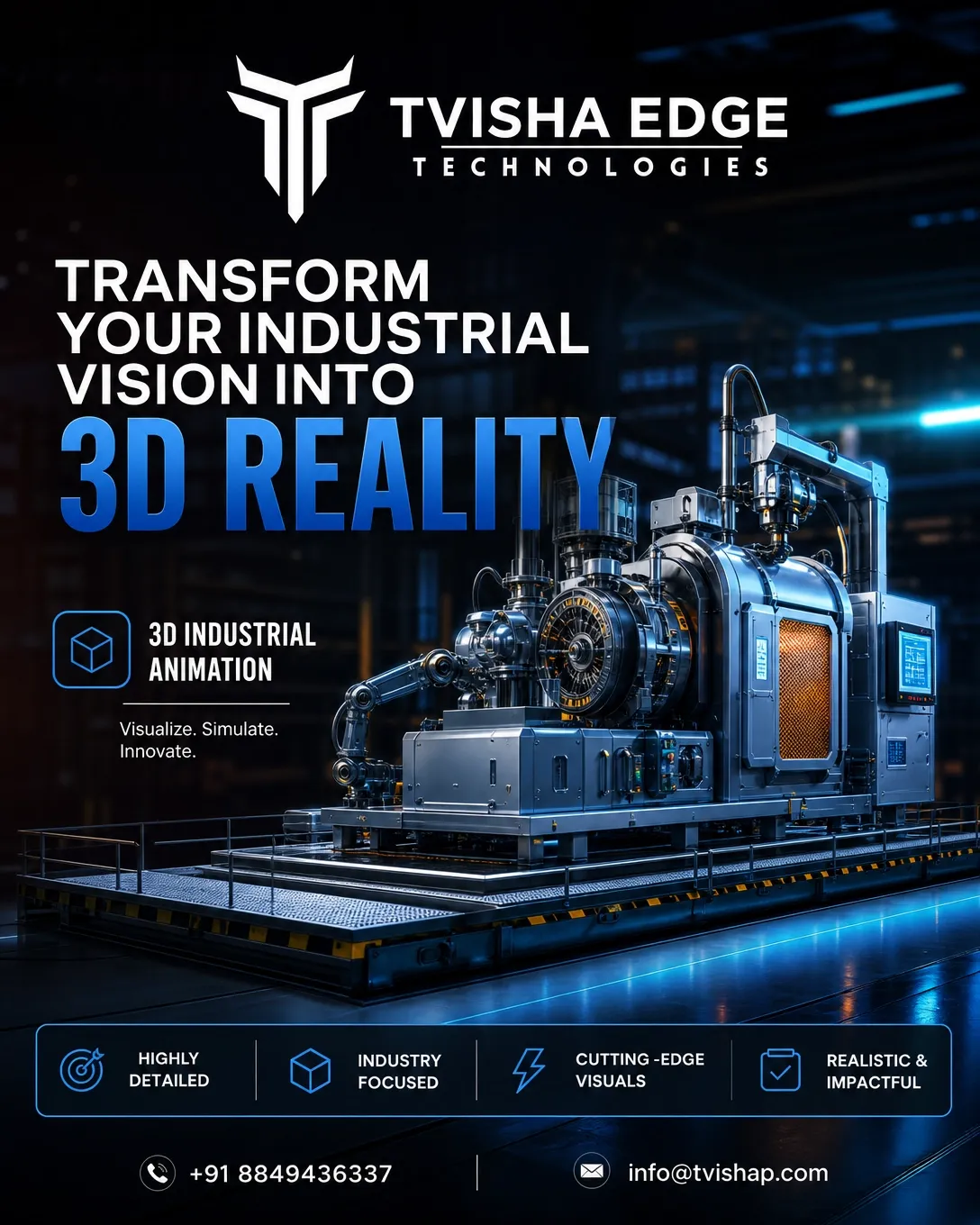
Boost Manufacturing Sales With 3D Industrial Animation by Tvisha Edge Technologies
If you have ever tried explaining a complex machine or industrial process to a potential client using only brochures or static photos, you already know the frustration. The client nods, but there is a good chance they have not fully grasped what your product does — or why they should choose it over a competitor. That communication gap costs real sales. This is exactly where 3D industrial animation changes the game, and why more Indian manufacturers are adopting it as a core sales and marketing tool.
Over the past decade, industries from heavy engineering to pharmaceuticals in cities like Pune, Surat, Vadodara, and Hyderabad have quietly shifted the way they pitch to procurement teams and end-users alike. Photorealistic animation is no longer just for multinational corporations. Mid-size manufacturers in Ahmedabad, Jaipur, and Indore are using it to win tenders, cut training costs, and generate qualified leads online — all at the same time.
Why Choose Tvisha for 3D Industrial Animation That Actually Sells?
Most animation vendors offer visuals. What industrial clients actually need is technical accuracy combined with the ability to communicate value clearly to a non-technical buyer. That distinction matters more than people realize.
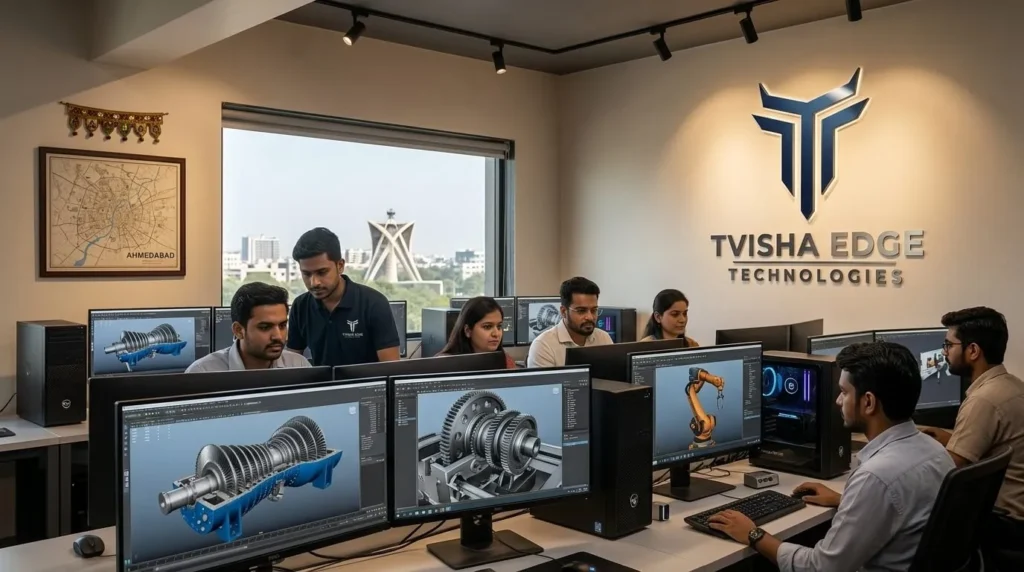
Tvisha Edge Technologies, based in Ahmedabad, has spent years working with manufacturing plants, engineering companies, and industrial product brands across India. The team comprises 3D animators, industrial visualization specialists, and technical content professionals who understand the difference between how a conveyor belt looks and how it actually operates under load. That operational accuracy is what builds buyer confidence.
Here is what genuine experience in this sector looks like: a rotary kiln manufacturer in Ahmedabad once spent 45 minutes in a client meeting trying to explain their liner replacement process. After a two-minute machine animation was added to their sales deck, that part of the conversation virtually disappeared — the client arrived already convinced. The meeting moved directly to pricing. That is the real commercial value of industrial visualization done well.
The team at Tvisha works with clients across sectors — cement, FMCG, defence manufacturing, pharma equipment, automotive components, and more. For a 3D Industrial Animation Studio Ahmedabad, this breadth of cross-sector experience means the team understands engineering tolerances, safety procedures, and assembly logic, not just polygon counts and render quality.
Internal links for further context:
- 3D Product Animation Services – Tvisha Edge Technologies
- Industrial 3D Animation Services – Full Capabilities Overview
- Plant Walkthrough Animation for Factories and Manufacturing Units
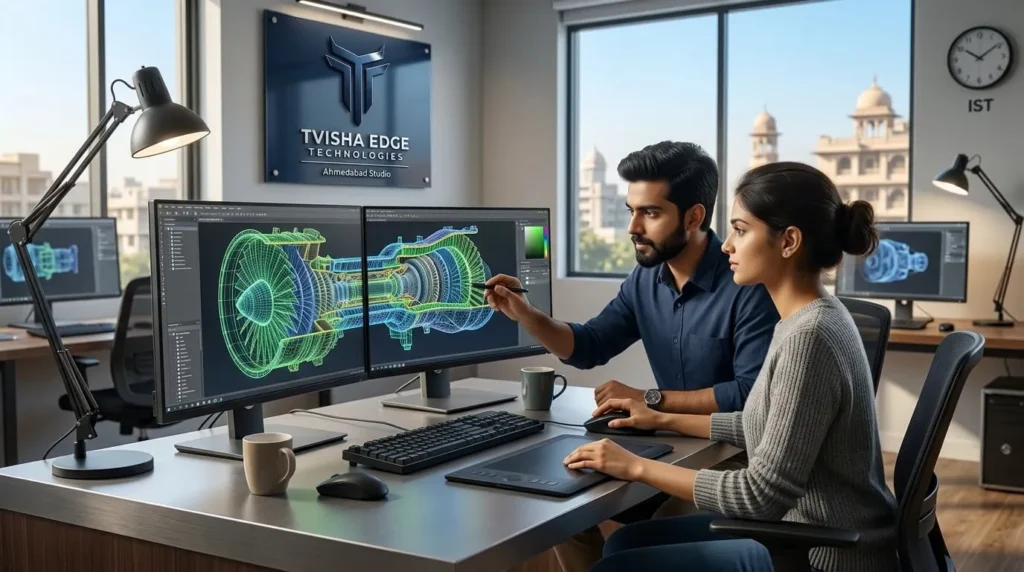
Our 3D Industrial Animation Capabilities: What You Can Actually Use
A common misconception is that 3D animation is only useful for product launches. In reality, the strongest ROI often comes from using it across multiple stages of the sales and operational lifecycle simultaneously.
Here is a realistic breakdown of what well-executed 3D visualization services can deliver for an industrial business:
- Machine animation — Showing moving parts, internal mechanisms, and assembly/disassembly sequences. Particularly valuable for capital equipment sales teams in Mumbai and Delhi pitching to procurement heads who are not engineers.
- Plant walkthrough animation — A virtual tour of a manufacturing facility or process flow. This is increasingly used in pre-bid presentations to government buyers and large PSU procurement committees.
- Manufacturing animation — Illustrating production processes, quality checks, and workflow efficiencies. Useful for investor presentations, ISO audits, and dealer network training.
- O&M animation — Operation and Maintenance videos that reduce field errors, service calls, and training time. A crane manufacturer in Chennai reduced their on-site technician training duration by nearly 30% using O&M animation modules.
- Training animation — Safety protocols, equipment handling, and process adherence modules used in onboarding and compliance programs. Companies in Chandigarh and Kolkata with large shop floor teams have found significant cost savings here.
- 3D product rendering — High-resolution still renders for e-commerce listings, catalogues, and exhibition backdrops. Far more cost-effective than multiple product photoshoots for companies with large SKU counts.
- Marketing animation — Short-form digital content for LinkedIn, trade publications, and exhibition screens. Industrial companies in Bangalore running targeted B2B digital campaigns report 2–3× higher engagement compared to image-only ads.
When these formats are combined strategically, the cumulative effect on both sales conversion and operational efficiency is significant. Tvisha’s approach involves understanding which combination best serves the client’s specific business goal — not simply producing a visually impressive file.
Additional resource: How 3D Animation Is Transforming Manufacturing Sales in India – Tvisha Blog
Navigating Quality Standards and Technical Accuracy in Industrial Animation
There is a reason why technically trained buyers become skeptical of animation that looks polished but gets the engineering wrong. An incorrect valve orientation or a physically impossible cam motion might be invisible to a layperson, but it immediately undermines credibility with an engineer or plant manager.
This is why technical accuracy is non-negotiable in genuinely useful industrial 3D animation. The workflow at a serious industrial animation company India should involve reference material review — actual CAD files, engineering drawings, SOP documents, and ideally a walkthrough with the client’s technical team before any modelling begins.
At Tvisha, the typical production workflow includes:
- Technical briefing — CAD/drawing review, discussion of mechanism logic, dimensional accuracy requirements
- 3D modelling phase — Component-level building with real-world scale and material properties
- Motion rigging — Physically accurate animation of moving parts with correct degrees of freedom
- Environment and context — Realistic plant environments, lighting conditions, and context-appropriate backgrounds
- Review and revision — Structured client feedback rounds with technical team involvement
- Delivery — Multiple formats optimized for web, social, presentation, and trade show use
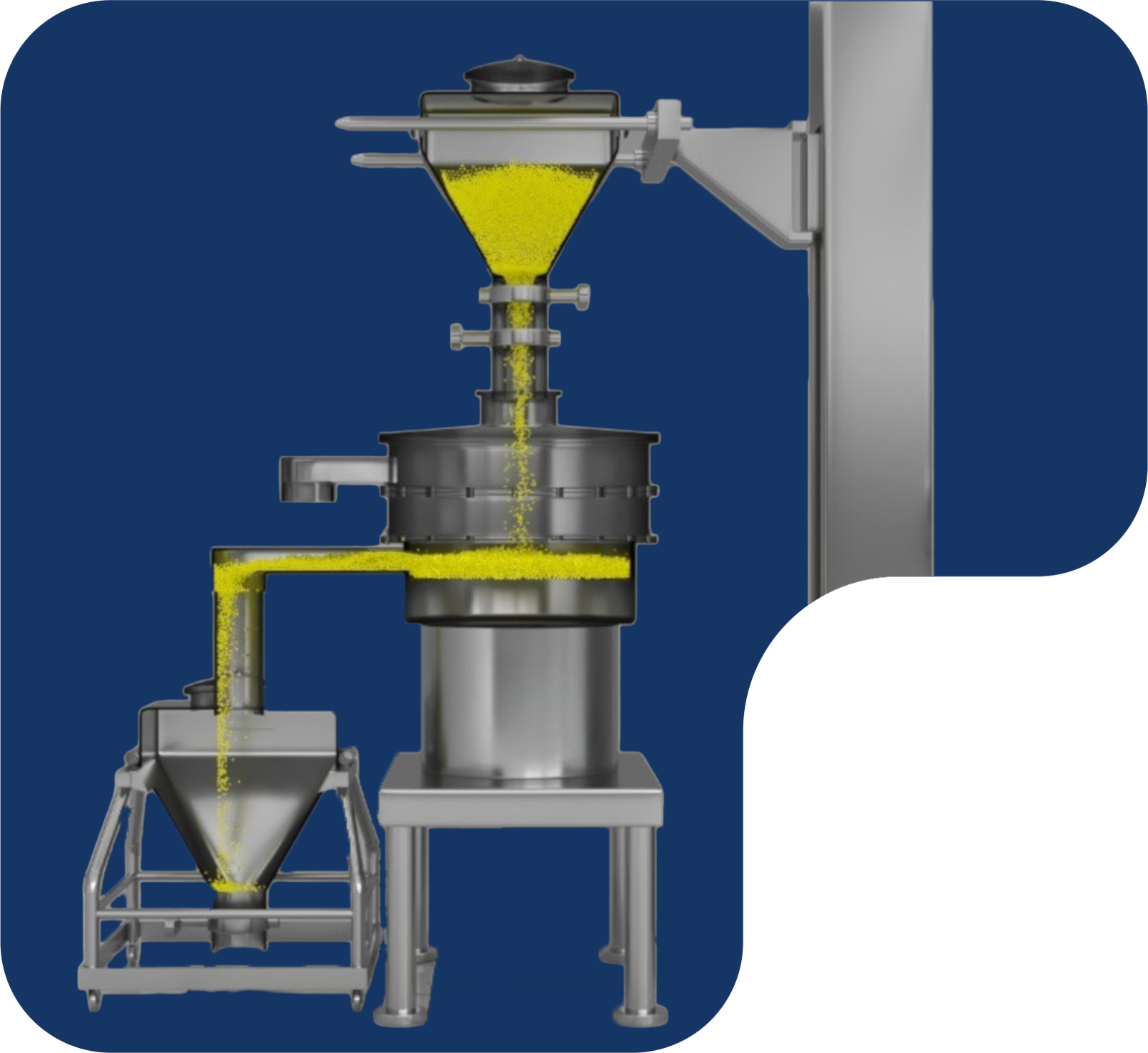
Photorealistic 3D animation is the output standard. This means light behaviour, surface materials (brushed steel, coated polymer, galvanized metal), fluid dynamics, and particle effects that mirror real-world conditions rather than approximating them. The visual credibility this creates in a B2B context is difficult to replicate through any other medium.

Local Studios vs Tvisha: A Practical Comparison
Many manufacturing companies — especially in Tier 2 cities like Vadodara, Indore, and Jaipur — have at some point hired a local animation freelancer or a general-purpose creative agency, only to receive outputs that look impressive on a monitor but fail during client or investor presentations because the technical details were inaccurate or the file quality was insufficient for large-format display.
Here is a straightforward comparison to help industrial buyers make an informed decision:
| Parameter | Local General Animation Studio / Freelancer | Tvisha Edge Technologies (Industrial Specialist) |
|---|---|---|
| Industry domain expertise | Generalist — handles motion graphics, explainers, entertainment | Focused on industrial, manufacturing, and engineering animation |
| Technical accuracy | Limited — often based on visual reference only | CAD-referenced, engineering drawing reviewed, mechanism validated |
| Photorealism level | Basic to moderate render quality | Studio-grade photorealistic output for B2B and exhibition use |
| O&M & training animation | Rarely available as a structured service | Dedicated service with SOP integration |
| Plant walkthrough capability | Not typically offered | Full factory/process walkthrough with operational context |
| Multi-format delivery | Usually one format (MP4/MOV) | Web, social, 4K exhibition, VR-ready formats as needed |
| Revision process | Often informal, time-consuming | Structured review rounds with dedicated project manager |
| SEO & digital integration | Limited or no guidance | Available through integrated digital marketing team |
| Suitable for PSU / government bids | Rarely | Yes — technical precision meets procurement expectations |
| Pan-India client experience | Typically regional | Clients across Ahmedabad, Mumbai, Delhi, Bangalore, Chennai, Hyderabad |
The practical implication: for a one-off social media reel, a generalist studio might suffice. For anything that will be shown in a client boardroom, trade show, or government tender presentation, the technical standard has to be higher.
Get QuoteStep-by-Step Process: How Tvisha Delivers 3D Industrial Animation That Boosts Sales
Understanding the production process helps industrial clients set realistic expectations and participate effectively in reviews — which directly improves the final output quality.
Here is how Tvisha approaches a typical 3D Product Animation Services engagement:
Step 1 – Discovery and Scope Alignment
The process begins with a detailed discovery session. Clients share their product or process details, target audience profile, intended use cases (sales deck, exhibition, training, web), and any existing CAD or design files. This session also clarifies what the animation must communicate — not just what it should show.
Step 2 – Concept Script and Storyboard
A written script and visual storyboard are developed before any 3D work begins. This ensures alignment on narrative flow, key visual moments, and call-to-action placement in the animation. Many clients in Mumbai and Bangalore who have worked with non-specialist studios report that skipping this step caused expensive revisions later.
Step 3 – 3D Modelling and Asset Development
Engineering drawings, CAD files, or dimensional reference images are used to build accurate 3D models. Material textures, colour schemes, and component labelling are all defined and client-approved at this stage.
Step 4 – Animation and Motion
Each moving part is animated with physical accuracy. Whether it is a gearbox mechanism, a robotic arm sequence, or fluid flow through a pipeline — motion is validated against actual operating logic. This phase also includes camera movement planning for maximum visual clarity.
Step 5 – Rendering and Post-Production
Photorealistic rendering, light simulation, and post-production colour grading are applied. Voiceover, subtitles, music, and annotation graphics are added if required. Multi-format masters are produced in this stage.
Step 6 – Review, Revisions, and Final Delivery
Structured review rounds ensure technical and brand accuracy. Final deliverables are provided in agreed formats — typically MP4 at multiple resolutions, plus loop-ready versions for exhibition screens.
Real Client Case Study: How a Valve Manufacturer in Vadodara Won a Major Export Tender
Client: Anonymized — Mid-size industrial valve and actuator manufacturer, Vadodara, Gujarat (referred to as “M/s Precision Flow Systems” for this case study)
Challenge: The company had been shortlisted for a significant procurement tender from a refinery project in the Middle East. Their product met every technical specification, but their bid presentation — standard PDF brochures and static photos — looked similar to a dozen other Indian bidders. The procurement committee in Dubai had explicitly mentioned they preferred “interactive and clear product demonstrations” in the shortlist communication.
What Was Created: Tvisha produced a three-minute industrial 3D animation covering the full product range — including internal flow path animations, material compatibility callouts, and a before/after reliability comparison using animated data overlays. A separate 90-second O&M animation module was also created showing field installation and maintenance procedures.
Result: M/s Precision Flow Systems was awarded the contract. Their sales director later noted that the animation package was specifically complimented during the debrief — the procurement panel found it easier to evaluate their product against competitors because the technical differentiation was immediately visible.
Lead Time: The entire animation package was completed and delivered in 18 working days, in time for the submission deadline.
Lesson: In export markets and high-value domestic tenders, visual communication quality is evaluated as a proxy for manufacturing quality. Companies that invest in professional Industrial 3D Animation Services India are often perceived as more technically sophisticated — even before the specification review begins.
“A pump manufacturer from Ahmedabad used to take 3–4 weeks to get dealer buy-in on a new product launch. After incorporating 3D product animation into their dealer onboarding kit, that cycle dropped to under a week — dealers were arriving at meetings already familiar with the product’s key features and installation points.”
Faqs
1. How does 3D industrial animation boost sales for manufacturing companies?
- 3D industrial animation helps manufacturing companies explain complex products in a simple visual format. Customers can clearly understand product features, working mechanisms, and benefits, which increases trust, shortens the sales cycle, and improves conversion rates.
2. Why is 3D industrial animation better than traditional product brochures?
- Traditional brochures rely on static images and text, while 3D industrial animation demonstrates products in action. It showcases internal components, operational processes, and technical details that are difficult to explain through printed materials, resulting in higher customer engagement.
3. Can 3D industrial animation help generate more qualified leads?
- Yes. High-quality 3D animations attract potential buyers on websites, social media platforms, trade shows, and digital campaigns. Better product understanding often leads to more qualified inquiries and improved lead quality.
4. Kya 3D industrial animation B2B sales increase kar sakta hai?
- Bilkul. Jab buyers kisi machine ya industrial process ko visually dekhte hain, to unhe product samajhne mein aasani hoti hai. Isse trust build hota hai aur purchase decision faster ho sakta hai, jo B2B sales growth mein help karta hai.
5. Industrial product launch ke liye 3D animation kyun use karna chahiye?
- 3D animation product launch ke dauran product ke features, applications, aur benefits ko effectively showcase karta hai. Isse customers aur stakeholders product ko launch se pehle hi achhi tarah samajh sakte hain.
6. Kya 3D industrial animation trade shows mein useful hai?
- Haan. Trade shows aur exhibitions mein 3D animations visitors ka attention quickly attract karte hain. Complex machinery ko live demonstration ke bina bhi effectively present kiya ja sakta hai, jisse engagement aur inquiries badhti hain.
7. What industries benefit the most from 3D industrial animation?
- Industries such as manufacturing, automotive, engineering, oil and gas, renewable energy, aerospace, pharmaceuticals, heavy machinery, and industrial automation gain significant benefits from 3D industrial animation for marketing, training, and sales presentations.


Comments
Post a Comment