Transform Business With Trusted Digital Partnership
How a Trusted Digital Partnership Can Transform the Way Indian Manufacturers Communicate, Grow, and Win
If you run a manufacturing unit in Ahmedabad, manage an engineering plant near Pune, or head a capital equipment business in Chennai — you already know the problem. Your machines are brilliant. Your process is tight. But the moment you put up a static PDF brochure or a grainy product video in front of a client in Mumbai or a buyer in Germany, the conversation slows down. They just can’t picture how your machine works, how your process flows, or why your product is superior. This communication gap costs real business every single year.
That’s exactly where a reliable, technically grounded digital partner — one who genuinely understands industrial complexity — makes a measurable difference. Tvisha Edge Technologies, based out of Ahmedabad, Gujarat, has spent years bridging that very gap for Indian manufacturers, engineering firms, and industrial brands. Through high-precision 3D industrial animation, immersive plant walkthrough animation, photorealistic product renders, and end-to-end digital solutions, the team helps industrial businesses tell their stories in a language clients actually understand — visually, precisely, and compellingly.
This article is for decision-makers — manufacturing owners, marketing heads, and engineering project managers — who are seriously evaluating whether a trusted digital partnership can deliver real, measurable ROI for their business. The short answer is yes. Here’s the full picture.
Why Tvisha Edge Technologies Is the Right Partner for Industrial Digital Transformation?
There’s a meaningful difference between a generic digital agency and a studio that truly understands industrial environments. Most animation vendors can make things look nice. Very few understand the difference between a reciprocating pump and a centrifugal one, or why the sequence of operations in a chemical process line matters when you’re explaining it to a client’s safety officer.
Tvisha was built specifically for this space. The team includes experienced 3D animators who’ve worked on projects spanning heavy engineering, pharmaceutical machinery, food processing lines, automobile components, and infrastructure. When a pump manufacturer from Vadodara approached the studio needing an animation that accurately depicted the internal fluid dynamics of their product for a Middle East tender, the team didn’t just animate — they studied the CAD files, understood the technical specifications, and created a photorealistic 3D animation that held up to scrutiny in the boardroom.
This technical accuracy is what separates a studio doing 3D product animation services for industrial clients from one making product videos for FMCG brands. The stakes are different. The audience is different. And the communication has to be airtight.
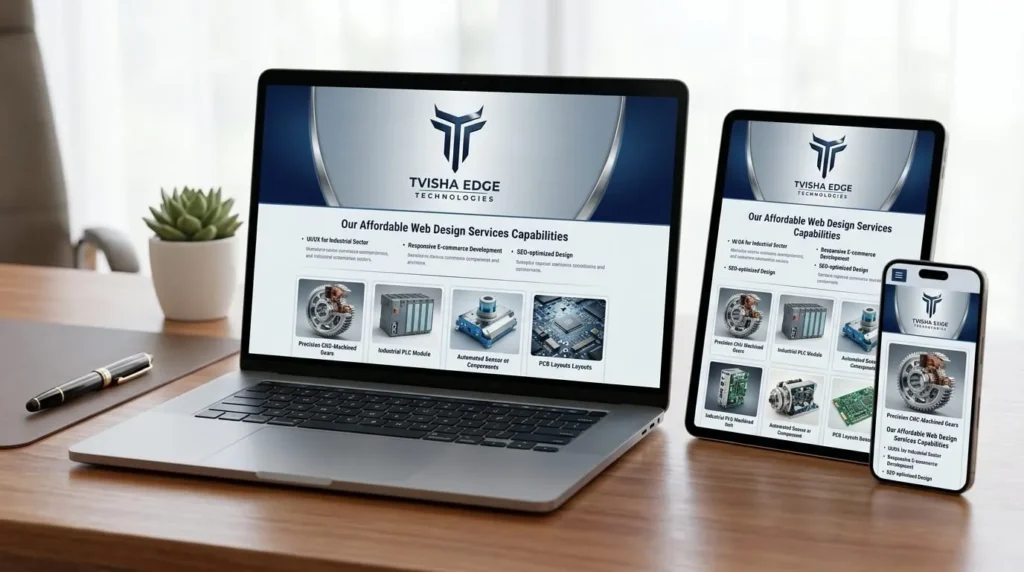
Beyond animation, Tvisha offers a full-suite digital partnership — from responsive website development and performance-led digital marketing to training animation and O&M manuals in video format. For an industrial business looking to consolidate its digital communication with one reliable partner, this breadth matters enormously.
Quick Win Story: A machine tool manufacturer from Jaipur was struggling to explain the advantages of their 5-axis CNC machining centre to procurement teams in Delhi. After a 45-day engagement with Tvisha, they had a 3-minute machine animation video that they played at an industry expo in Bengaluru. Three inquiries converted into purchase orders within 60 days of the event.
Animation Capabilities That Cover the Full Industrial Communication Lifecycle
Most industrial businesses need more than one type of animation over the course of a product’s life — from pre-sales to post-installation training. Here’s what a complete engagement with Tvisha typically covers:
Machine Animation for Sales & Marketing: Machine animation is where most clients start. Whether it’s a packaging machine, a hydraulic press, a compressor, or a precision mould — animating how the machine operates, what it produces, and why it’s reliable helps shorten B2B sales cycles significantly. A well-made 2–3 minute machine animation can replace a 45-minute live demo in many situations, especially for remote or international prospects.
Plant Walkthrough Animation for Large Projects: Plant walkthrough animation lets engineers, investors, and clients virtually walk through a facility before the first brick is laid — or before they commit to a purchase. For EPC contractors in Hyderabad, this has become nearly essential for international client pitches. For industrial real estate developers in Surat, it helps visualize the final state of a project months in advance.
Manufacturing Process Animation: Manufacturing animation explains how raw materials transform into finished goods — step by step — in a way that text and 2D diagrams simply cannot. It’s particularly useful for export-oriented businesses trying to communicate their process quality to international buyers unfamiliar with Indian industrial standards.
O&M Animation and Training Videos: O&M animation (Operation & Maintenance) is an often-overlooked but high-value use case. Instead of thick manuals that technicians ignore, animated O&M guides ensure that on-site personnel in remote plants — say in Chandigarh or interior Kolkata — can follow maintenance procedures accurately and safely. Training animation also significantly reduces onboarding time for new operators.
3D Product Rendering for Catalogues and Digital Marketing: 3D product rendering creates photorealistic images of products that look better than real photographs — because they can be controlled for lighting, angle, background, and detail. For manufacturers who need high-quality images for their website, Amazon listings, or export catalogues, rendering is far more cost-effective than a photo studio shoot, especially when the product is large, heavy, or still in production.
Navigating Quality Standards and Technical Accuracy in Industrial Animation
This is the section most vendors skip — and it’s the one that matters most to engineers and quality-conscious manufacturing clients.
When a steel plant in Indore asks for a detailed animation of their rolling mill process, accuracy is non-negotiable. The animation can’t just look good — it must be technically correct. Dimensions, clearances, motion sequences, speeds, and process logic all need to reflect the actual engineering. If the animation shows a valve opening before pressure builds — when in reality it should be the other way around — any trained engineer in the client’s organization will catch it, and it will destroy credibility instantly.
Tvisha’s workflow includes a dedicated technical review phase where client engineers or project managers review animation sequences before final rendering. This is not just a checkbox — it’s an integral step where the studio actively invites feedback on process accuracy, component detail, and sequence logic. The result is animation that passes scrutiny, not just screens.
For projects involving CAD data — SolidWorks, AutoCAD, CATIA, or Inventor files — the studio works directly with the client’s 3D models where possible, preserving dimensional accuracy and reducing modelling time. When CAD files aren’t available, the team builds models from engineering drawings, reference images, and technical specifications.
Quality standards at Tvisha also extend to output specifications — render resolution (typically 4K or higher for large screens), animation frame rates, file formats for broadcast or digital delivery, and compression settings optimized for web without quality loss.
For clients who want to use animation in international tenders, trade fair presentations, or investor decks, this level of quality discipline is essential. And for those exporting to Europe or the Gulf, where technical content is heavily scrutinized, it can be the difference between shortlisting and rejection.
Local Studios vs Tvisha – An Honest Comparison
Indian manufacturers often evaluate multiple vendors — some local freelancers, some Tier-1 city agencies, and occasionally international studios. Here’s an honest breakdown of how these options compare across the dimensions that matter most for industrial animation projects:
| Factor | Local Freelancers / Small Studios | Generic Digital Agencies | Tvisha Edge Technologies |
|---|---|---|---|
| Industrial Technical Knowledge | Often limited; general 3D skills | Minimal; focused on visual appeal | Deep; engineering + manufacturing domain experience |
| CAD-to-Animation Capability | Rare; usually rebuilds from scratch | Not available in most cases | Available; works with SolidWorks, AutoCAD, CATIA |
| Photorealistic Output Quality | Varies widely; inconsistent renders | Basic to moderate quality | Consistent photorealistic 4K output standard |
| Technical Review Process | Usually none or informal | Client-driven only | Built-in structured technical review stages |
| Full Digital Suite (Web + Marketing) | Animation only; limited scope | Marketing only; no industrial animation | End-to-end: animation + web + digital marketing |
| Project Communication | Informal; WhatsApp-only | Account manager model | Dedicated project manager + milestone tracking |
| Scalability for Long-Term Partnership | Limited; risk of vendor unavailability | Moderate; may lack animation depth | High; full team, infrastructure, and process in place |
| IP & NDA Compliance | Often informal agreements | Standard contracts | Formal NDA, IP ownership clauses, and data security |
Step-by-Step: How Tvisha Delivers Industrial Animation and Digital Solutions
Understanding the process helps clients set realistic expectations and engage more productively. Here’s how a typical project unfolds at Tvisha:
Step 1 – Discovery and Scope Definition
- Every engagement starts with a detailed discovery call or meeting. The studio’s team gathers information about the product or process, the target audience (end-user, B2B buyer, investor, operator), the intended use (sales pitch, trade show, training, O&M), and the delivery timeline. At this stage, clients are encouraged to share CAD files, engineering drawings, reference videos, and technical specifications.
Step 2 – Script and Storyboard Development
- Before a single polygon is built, the studio develops a narrative script and visual storyboard. This is critical because it aligns the client’s communication goals with the animation structure. A machine animation for a sales pitch needs a different narrative arc than an O&M animation for a service technician.
Step 3 – 3D Modelling and Scene Construction
- The 3D modelling phase is where the product or process is built in virtual 3D space. For complex machines, this can involve hundreds of individual components, each with correct materials, finishes, and mechanical relationships. Scene environments — factory floors, outdoor installations, laboratory settings — are built with enough realism to support photorealistic rendering.
Step 4 – Animation, Lighting, and Technical Review
- Once modelling is approved, animation sequences are developed — motion paths, mechanical movements, fluid simulations, camera movements. This is where the technical review loop happens: client engineers verify that the process sequence, component movements, and timing are all accurate before render begins.
Step 5 – Rendering and Post-Production
- High-resolution rendering is computationally intensive — this is where professional render infrastructure matters. After rendering, the studio handles post-production: color grading, adding voiceover or music, adding titles, supers, and branding elements to produce a broadcast-quality final file.
Step 6 – Delivery, Formats, and Revision Management
- Final delivery includes the animation in all required formats — MP4 for web, MOV for broadcast, compressed versions for email or WhatsApp sharing. Revision rounds are managed systematically. All source files and assets are organized and handed over as specified in the project agreement.
Real Client Case Study: How a Gujarat-Based Industrial Equipment Manufacturer Won a ₹4.2 Crore Export Order
Client Background (Anonymized)
Client: Precision Fluid Systems Pvt. Ltd. (name changed), a mid-sized manufacturer of industrial pumps and valves based in Ahmedabad. Annual turnover: ₹18 crore. Primary market: domestic industrial customers. Goal: break into Gulf Cooperation Council (GCC) export markets.
The Challenge
The client had strong products — well-engineered, competitively priced, and certified — but their sales collateral was entirely text and photograph-based. At a 2023 industrial trade fair in Dubai, they couldn’t effectively communicate the internal workings of their flagship double-diaphragm pump to international buyers who couldn’t read Hindi-language technical documents and weren’t familiar with the brand. Two potential distributors passed without engaging further.
What Tvisha Delivered
Tvisha was engaged for a 60-day project. The scope included:
- A 3.5-minute photorealistic 3D industrial animation of the double-diaphragm pump — showing cutaway internal views, fluid movement, valve operation, and maintenance access points
- A 90-second plant walkthrough animation of the client’s manufacturing facility, emphasizing quality control stations and certifications
- An updated company website with a dedicated export-market landing page optimized for Gulf region buyers
- A set of photorealistic 3D product renders for the updated catalogue (both print and digital)
The Result
At the 2024 edition of the same Dubai trade fair, the client played the animations at their booth on a large display screen. Within two days of the event, they had four serious inquiries from regional distributors. Within five months, they signed a supply agreement with a UAE-based industrial distributor — their first confirmed export contract — valued at ₹4.2 crore over 18 months.
The client’s marketing manager noted: “The animation did what our brochures never could — it made our engineers look like the experts they actually are, to people who had never heard of us before.”
Key Takeaway
Industrial animation and digital communication aren’t expenses — they’re investments in credibility and reach. For a manufacturer in Ahmedabad targeting buyers in Mumbai, Delhi, Bangalore, or the Gulf, the ability to communicate technical excellence visually is a genuine competitive differentiator.
FAQs
1. What is a trusted digital transformation partner?
- A trusted digital transformation partner helps businesses modernize operations, automate workflows, implement advanced technologies, and create scalable digital strategies that improve efficiency, customer experience, and long-term growth.
2. How can digital transformation improve business growth?
- Digital transformation boosts productivity, reduces operational costs, enhances customer engagement, improves decision-making with data, and enables businesses to scale faster while staying competitive in changing markets.
3. Which businesses benefit most from digital transformation services?
- Startups, SMEs, enterprises, manufacturers, healthcare providers, retailers, logistics companies, and financial organizations all benefit from digital transformation through automation, cloud solutions, AI integration, and digital marketing.
4. Digital transformation ke liye right technology partner kaise choose kare?
- Ek trusted technology partner industry experience, customized solutions, transparent communication, scalable technologies, strong support, aur proven project delivery ke basis par choose karna chahiye.
5. Kya digital transformation sirf bade businesses ke liye hai?
- Nahi. Small businesses aur startups bhi digital transformation se automation, better customer experience, online visibility, aur business growth achieve kar sakte hain without massive investments.
6. Digital transformation me AI aur automation kitna important hai?
- AI aur automation repetitive tasks ko automate karte hain, customer support improve karte hain, data-driven decisions enable karte hain, aur businesses ko faster, smarter, aur more efficient banate hain.
7. Why should businesses invest in digital transformation today?
- Businesses should invest today because digital transformation increases agility, strengthens cybersecurity, improves customer satisfaction, supports AI adoption, and creates a sustainable competitive advantage for future growth.


Comments
Post a Comment