Transform Engineering Skills Through Virtual Innovation
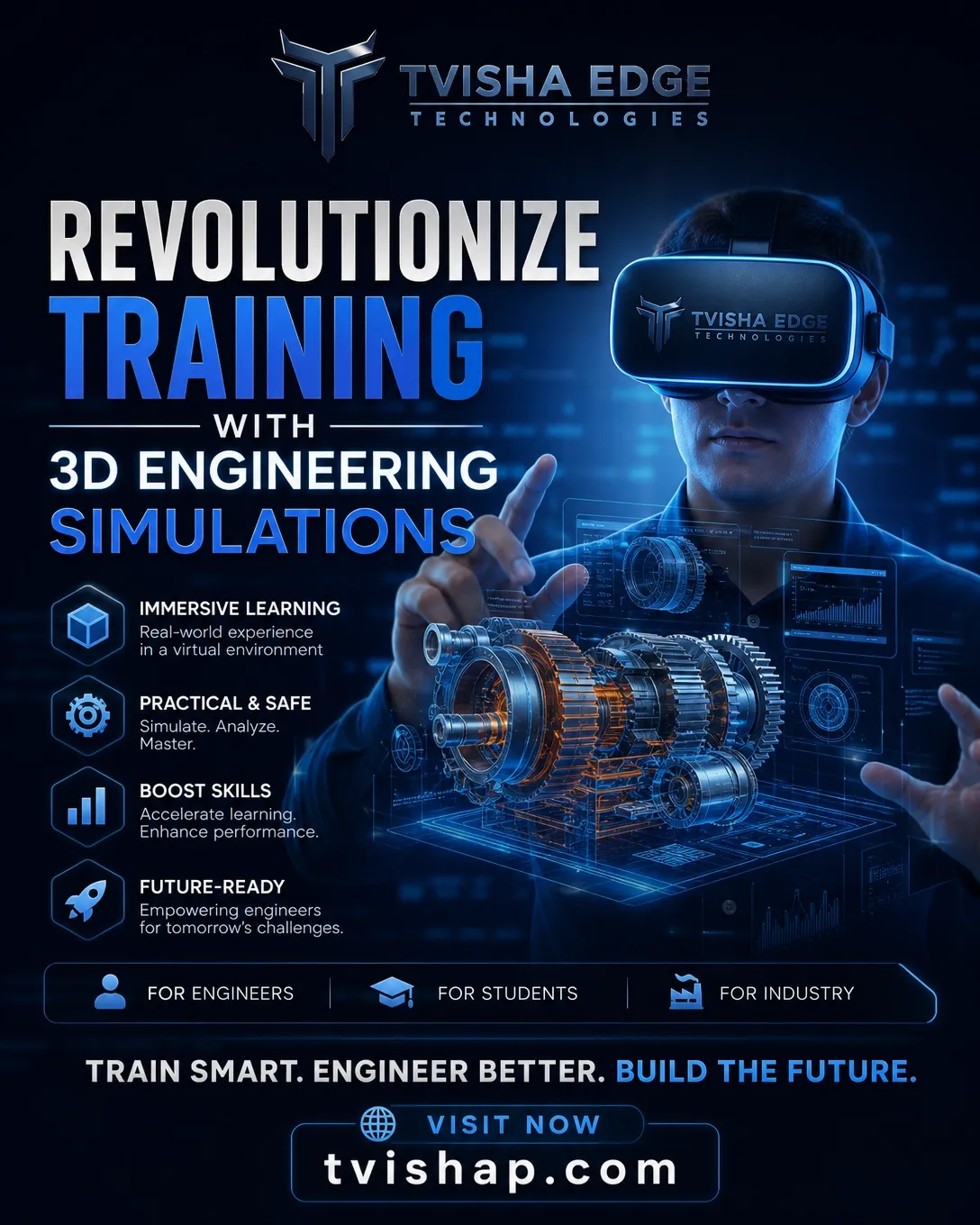
How Can Virtual Innovation Transform Engineering Skills for Future-Ready Professionals?
Virtual innovation transforms engineering skills by combining immersive 3D simulations, interactive learning, and real-world practice in a risk-free environment. Engineers and students gain hands-on experience, improve technical accuracy, strengthen problem-solving abilities, and adapt to modern industrial technologies faster. Tvisha Edge Technologies delivers advanced virtual engineering solutions that help organizations, educational institutions, and professionals build industry-ready expertise, reduce training costs, enhance safety, and prepare confidently for the evolving demands of Industry 4.0 and digital transformation.
If you’ve ever stood on a shop floor trying to explain a machine’s internal cycle to a new operator using a paper manual, you already know the problem. Engineering knowledge lives in people’s heads, in old PDFs, in tribal memory passed down from senior technicians to juniors over chai breaks. Virtual innovation — specifically 3D industrial animation — is changing how manufacturing companies pass that knowledge on, train teams, and pitch projects to clients who’ve never set foot in the factory. Over 15 years of working with engineering and manufacturing clients across India, this shift from static drawings to interactive, visual learning has been one of the most practical upgrades a plant can make. This article walks through what that transformation actually looks like, what it costs, and how a studio like Tvisha Edge Technologies approaches it.
Why Choose Tvisha for Transform Engineering Skills Through Virtual Innovation?
Engineering teams don’t need flashy animation for the sake of it — they need accuracy. A gearbox rendered beautifully but mechanically wrong does more harm than a rough 2D diagram that’s correct. That’s the first thing any manufacturing head in Ahmedabad, Surat, or Vadodara should check before hiring a studio: does the team understand tolerances, assembly sequences, and how machines actually behave under load?
Tvisha’s team has spent over a decade working alongside mechanical, electrical, and process engineers rather than just illustrators. That background matters when you’re animating a CNC machine’s tool path or a boiler’s O&M sequence — get the sequence wrong and you’re training someone incorrectly, not just making a pretty video. As an industrial 3D animation studio Ahmedabad based team, we’ve built animations for pump manufacturers in Pune, textile machinery makers in Surat, and packaging equipment companies in Chennai, each with very different technical requirements.
The honest answer to “why hire an animation studio for engineering training” is simple: reading comprehension varies, but visual comprehension is close to universal. A new operator in Jaipur and a distributor in Kolkata will both understand a well-made 3D walkthrough faster than a 40-page manual, regardless of their first language.
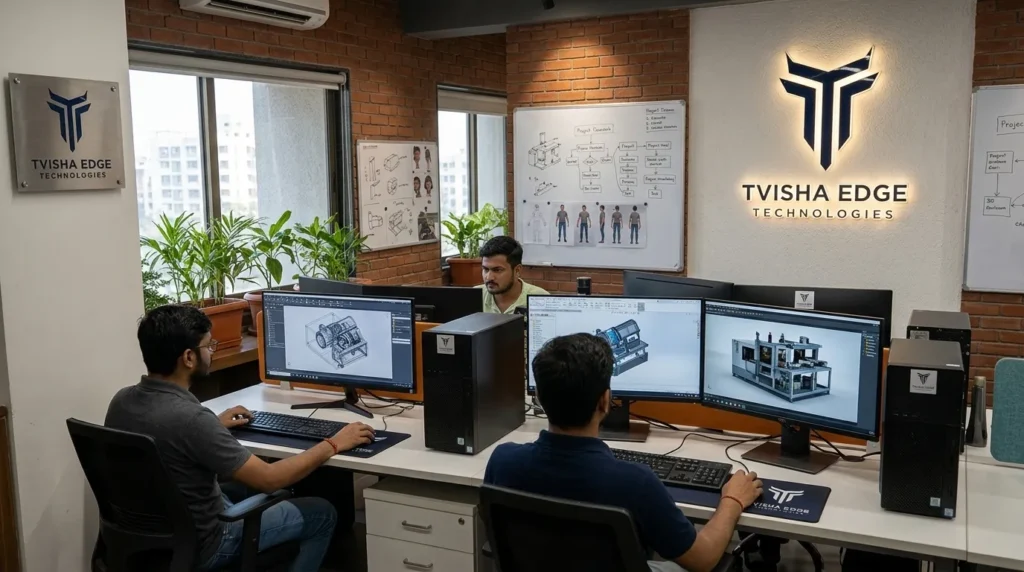
Our Transform Engineering Skills Through Virtual Innovation Animation Capabilities
Yes, we provide a full range of formats depending on what the engineering problem actually is. Not every client needs a cinematic product film — some need a functional training tool, others need a sales asset.
- Machine animation showing internal moving parts, cams, gears, and cycle timing that would be impossible to film on a real production line without stopping it.
- Plant walkthrough animation for greenfield projects, where the factory doesn’t physically exist yet but investors and clients need to see it.
- O&M animation (Operations & Maintenance) that breaks down startup, shutdown, and emergency procedures step by step — this has become one of the most requested formats from clients in Hyderabad and Indore over the last two years.
- Manufacturing animation covering entire process lines, from raw material intake to finished goods packaging.
- 3D product rendering for catalogues, exhibitions, and e-commerce, where photorealistic quality matters more than motion.
- Training animation modules that HR and safety teams use for onboarding, often paired with voiceover in Hindi, English, or regional languages.
Each of these draws on the same underlying 3D model, which is worth mentioning because it’s a genuine cost-saving insight: a single accurate CAD-to-3D conversion can be reused across a product animation, a training video, and a trade-show render, instead of paying for three separate builds.
Navigating Quality Standards & Technical Accuracy
The best industrial animation work starts with data, not imagination. When a client in Mumbai sends over CAD files, IGES or STEP data, we rebuild the geometry rather than eyeballing it from photographs — this is the difference between an animation that looks right and one that actually reflects how the machine functions.
Technical accuracy also means understanding material behavior. Metal doesn’t move like plastic under vibration; fluid dynamics in a mixing tank look different from air flow in an HVAC duct. A studio that treats every animation the same way, regardless of the physics involved, will eventually produce something an engineer in the room immediately flags as wrong — and once that trust is broken, the whole video loses credibility with the technical audience it was made for.
Quality control on our end typically involves at least two internal review rounds against the original engineering drawings before a draft even reaches the client, plus a final sign-off round with the client’s own engineering team. This is slower than a purely creative production process, but for industrial 3D animation services India buyers, that extra rigor is usually the reason they come back for their next product line.
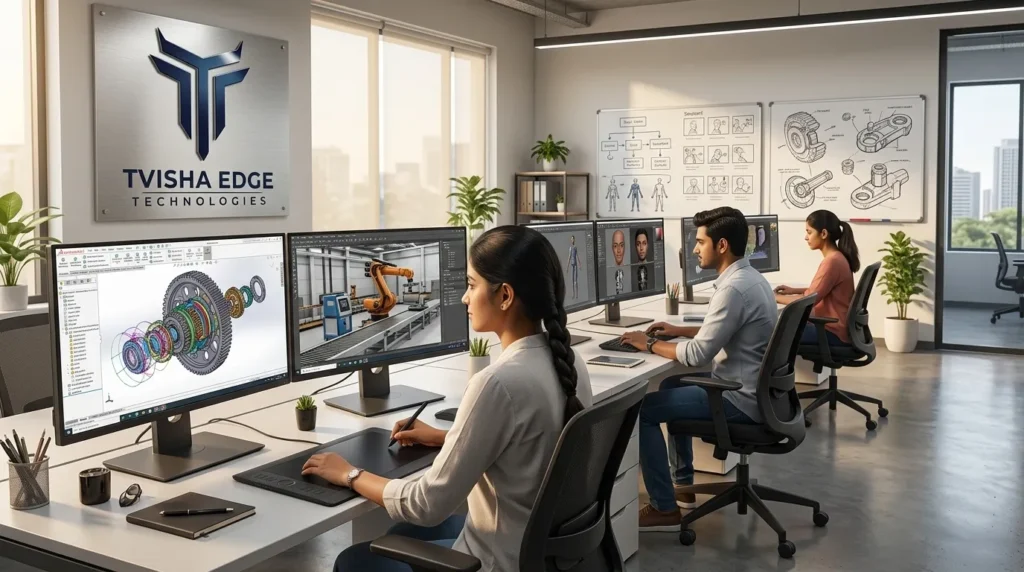
Local Studios vs Tvisha
Manufacturing companies in cities like Chandigarh or Indore often start their search locally, which makes sense — but the animation industry doesn’t really work on proximity the way, say, a printing vendor does. Here’s a practical comparison based on common client questions:
| Factor | Typical Local/Generalist Studio | Tvisha |
|---|---|---|
| Engineering background | Mostly design/animation trained | Team experienced with CAD, mechanical drawings, and industrial processes |
| CAD/STEP file handling | Often requires manual re-modeling | Direct CAD-to-3D pipeline reduces rework |
| Sector focus | Broad — ads, weddings, real estate, industrial mixed | Focused on industrial and manufacturing visualization |
| Revision process | Varies, often informal | Structured technical review before client delivery |
| Turnaround for O&M/training videos | Depends on generalist bandwidth | Dedicated workflow for training and O&M formats |
This isn’t to say generalist studios can’t produce good work — many do, especially for simpler product shots. But for a plant walkthrough with 40 pieces of equipment or a safety training module that has to be technically defensible, the difference tends to show up during the first revision round.
Get QuoteStep-by-Step Process – How We Deliver Transform Engineering Skills Through Virtual Innovation?
Here’s how Tvisha typically structures a project, from a client’s first enquiry to final delivery:
- Discovery call — understanding the actual goal: is this for investor presentations, operator training, a trade show, or a sales website?
- Data collection — CAD files, technical drawings, site photos, or in some cases a physical site visit for plant walkthroughs.
- Storyboard and script — a rough sequence showing camera angles, callouts, and narration points, shared for client approval before any 3D work starts.
- 3D modeling and texturing — building or refining geometry to match real dimensions and finishes.
- Animation and technical review — motion is added and checked against engineering logic, not just visual appeal.
- Rendering — photorealistic 3D animation output, usually in 4K, with lighting matched to the intended use (studio-style for products, factory-realistic for walkthroughs).
- Client review and revisions — typically two structured rounds are included before final handoff.
- Delivery — final files in formats suited for web, exhibition screens, LMS training platforms, or investor decks.
A Bangalore-based capital equipment manufacturer we worked with needed the full cycle completed in under five weeks ahead of an international trade show — tight, but achievable because the CAD data was clean and client feedback rounds were scheduled in advance rather than left open-ended.
Real Client Case Study
A mid-sized packaging machinery manufacturer based near Ahmedabad (referred to here as “Client A” for confidentiality) approached us with a recurring problem: their after-sales team was spending significant time on phone support because new equipment operators at customer sites struggled with the printed O&M manual, particularly around the changeover procedure between packaging sizes.
We converted their existing 2D technical drawings and machine CAD data into a set of O&M animation modules — one covering standard startup and shutdown, one covering the changeover sequence, and one covering common fault troubleshooting. Each module ran under four minutes, with bilingual voiceover (English and Hindi) and on-screen callouts matching the physical controls on the machine.
Within the first quarter after rollout, the client reported a noticeable drop in repeat support calls related to changeover errors, and their sales team began using the same animation set as a pre-sales demonstration tool for prospective buyers in Rajasthan and Madhya Pradesh — an unplanned but welcome secondary use of the same asset. It’s a good example of how training-focused work can double as 3D product animation services for business development, without any extra production cost.
For manufacturers evaluating 3D industrial animation studio Ahmedabad options, this kind of dual-purpose outcome is worth asking about upfront — a well-scoped project brief can often build both a training tool and a sales tool from the same footage.
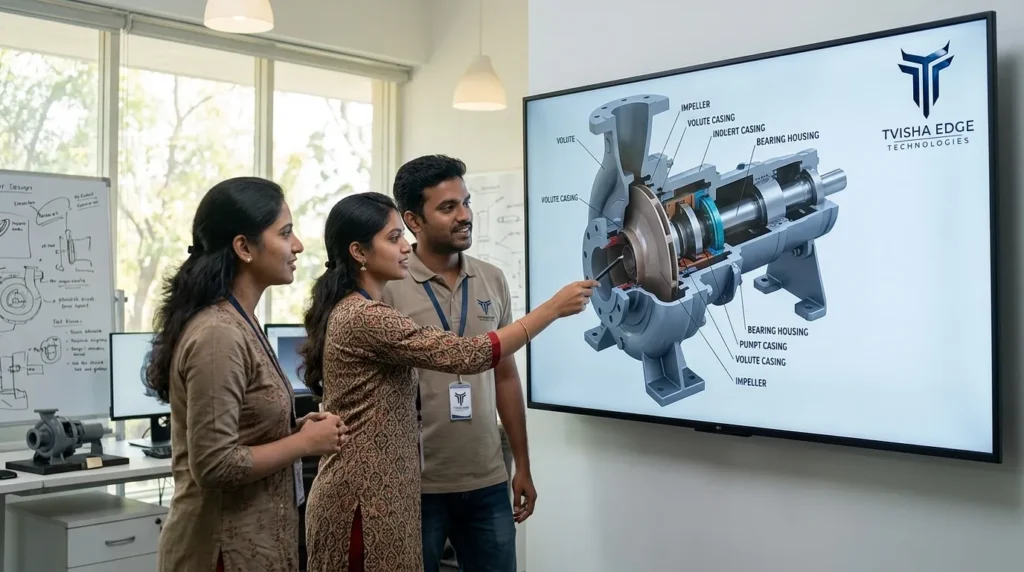
Frequently Asked Questions
1. What is virtual engineering training?
- Virtual engineering training uses VR, AR, and 3D simulations to provide hands-on learning in a safe digital environment. It helps engineers and students understand complex concepts faster while improving practical skills.
2. How do engineering simulations improve learning outcomes?
- Engineering simulations allow learners to practice real-world scenarios without physical risks. They increase knowledge retention, reduce training costs, improve decision-making, and build confidence before working on actual equipment.
3. Why are immersive simulations important for Industry 4.0?
- Immersive simulations prepare engineers for smart manufacturing, automation, digital twins, and AI-driven workflows. They bridge the gap between classroom learning and modern industrial requirements.
4. Virtual engineering training beginners ke liye useful hai?
- Haan. Virtual engineering training beginners ko real-world equipment aur industrial processes safely samajhne ka mauka deta hai. Isse practical knowledge aur confidence dono improve hote hain.
5. Kya 3D engineering simulations se placement opportunities improve hoti hain?
- Bilkul. 3D simulations se students aur professionals industry-ready skills develop karte hain, jo interviews, internships aur placements ke dauran unhe competitive advantage deti hain.
6. Engineering students ko VR-based learning kyun choose karna chahiye?
- VR-based learning complex engineering concepts ko interactive aur visual banata hai. Isse learning engaging hoti hai, mistakes safely practice ki ja sakti hain, aur practical understanding kaafi better ho jati hai.
7. Which industries benefit most from virtual engineering simulations?
- Industries such as manufacturing, automotive, aerospace, construction, energy, robotics, healthcare, and industrial automation use virtual engineering simulations to enhance workforce training, safety, and operational efficiency.


Comments
Post a Comment