3D Safety Animation Services: Effective Safety Training
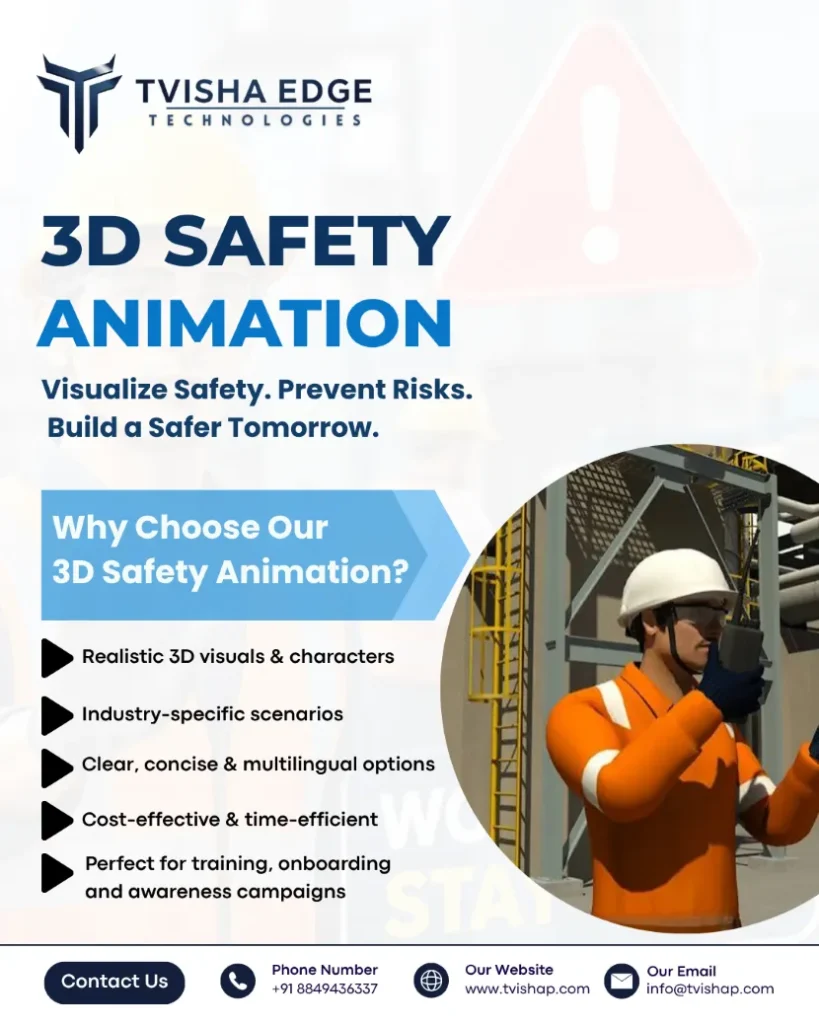
Most workplaces already have safety rules. The harder question is whether people remember them at the moment it matters. Thick manuals get skimmed, and slide decks get forgotten by the next shift.
3D safety animation services take a different route. Instead of describing a hazard, they show it, step by step, in a way that people understand the first time they watch. This guide explains what these services include, why they work, and how to build an animation that actually changes behaviour on the shop floor.
What Are 3D Safety Animation Services?
3D safety animation services turn workplace safety procedures into computer-generated visual stories. Designers build accurate 3D models of machines, tools, plants and work areas. They then animate the correct steps, the possible hazards and what happens when someone takes a shortcut.
Live footage can only show what a camera can reach. Animation has no such limit. It can open up a pressure vessel, follow a chemical through a pipeline, or trace the swing path of a crane load, all without exposing anyone to risk.
Most projects also include narration, on-screen text and sound effects, so a single video can serve trainers, supervisors and new hires alike.
Why Animation Beats Traditional Safety Training
Written SOPs, lectures and slides struggle when the subject is technical or the audience speaks several languages. Employees can attend a full session and still miss the steps that matter.
Animated training solves this in three ways:
- It shows instead of telling. Viewers watch each step in the correct order.
- It makes hidden risks visible. Gas leaks, electrical arcs and moving internal parts become easy to grasp.
- It reduces reliance on the trainer. Every employee gets the same message, on every shift.
People also tend to remember a demonstrated process better than a described one, which is why visual instruction is widely used in technical training.
Key Benefits of 3D Safety Animation for Businesses
Clearer understanding
A lockout/tagout sequence is much easier to follow when each valve and switch is highlighted on screen in the right order.
Better retention
Employees remember what they see in motion, so procedures are applied more consistently on the job.
Consistent training quality
Every batch of trainees watches the same accurate content, which removes the variation that comes from different trainers.
Multilingual flexibility
One animation can carry voice-overs and subtitles in English, Hindi, Gujarati or any other language your workforce needs.
Lower cost over time
You produce the video once, then reuse it for onboarding, refresher sessions and audits.
Safe demonstration of dangerous events
Fires, falls and equipment failures can be shown realistically with zero real danger.
Safety Topics You Can Explain Through 3D Animation
Almost any procedure with a physical process can be animated. The most common topics include:
- Machine safety: guarding, safe operation, emergency stops and maintenance isolation
- Process safety: chemical handling, pressure systems, reactor operations and leak response
- Fire safety: evacuation routes, extinguisher use and how fire spreads
- Working at height: harness use, scaffolding checks and fall prevention
- Electrical safety: lockout/tagout, arc flash hazards and safe isolation
- PPE awareness: correct selection, fitting and use of protective equipment
- Emergency response: assembly points, alarm signals and first-response actions
- Material handling: forklift movement, crane operation and load safety
A short awareness clip works well for daily toolbox talks, while longer animations suit induction programs and procedure-based training.
Industries That Use 3D Safety Animation Services
Any industry with physical risk can benefit from animated training.
- Manufacturing: line safety, machine operation and maintenance procedures, especially for high-speed or automated equipment.
- Construction: sites change daily, so hazards change too. Animation can cover excavation, scaffolding, lifting and site traffic before work begins.
- Oil, gas and chemicals: animations explain how a process works and what can go wrong at each stage.
- Power and utilities: electrical isolation, substation entry and high-voltage precautions are easier to teach with a visual model.
- Pharmaceuticals and food processing: hygiene rules, cleanroom behaviour and equipment cleaning steps can be shown clearly and consistently.
- Warehousing and logistics: forklift routes, racking safety and manual handling become simple to understand.
Plant-level training also benefits from spatial context. For example, 3D plant animation shows how equipment, pipelines and safe zones connect across a facility, so employees understand the risks around their task and not only the task itself.
How to Create an Effective 3D Safety Animation
A strong safety animation follows a clear process. Skip a step and you often end up with a video that looks impressive but teaches very little.
- Define the training goal. Decide what employees must do differently after watching. One clear objective keeps the video focused.
- Identify the audience. New hires, operators and supervisors need different levels of detail, and language and literacy levels matter too.
- Collect accurate source material. Use SOPs, P&IDs, CAD models, incident reports and site photos. Technical accuracy builds trust with viewers.
- Write a simple script and storyboard. Keep sentences short and teach one point per scene, in the order hazard, correct action, result.
- Build and animate the 3D models. Realistic equipment and environments help employees connect the video to their own workplace.
- Add narration, text and sound. Use clear voice-overs and subtitles, and highlight critical steps with callouts or colour changes.
- Review with safety experts. Your EHS team should check every step against internal rules and applicable standards. Guidance such as OSHA's safety and health program recommendations and the ISO 45001 standard can help shape the content.
- Deploy and measure. Use the video in inductions, toolbox talks and refreshers, then track quiz results and incident trends to see what improves.
Branding plays a small but useful role. A consistent visual identity makes internal videos look professional. If your company needs a fresh look, 3D logo design and animation can create a matching intro for your training series.
Why Choose Tvisha Edge Technologies?
Tvisha Edge Technologies is a 3D industrial animation studio in Ahmedabad. The team of 3D animators and industrial visualization professionals creates high-precision animation for manufacturing, engineering and industrial clients across India and international markets.
- Technical accuracy: work is built from your drawings, SOPs and process data, so every step is correct.
- Photorealistic quality: machines and plants look like your actual facility.
- Wide industrial experience: machine animation, industrial process animation, plant walkthroughs, O&M animation and training videos.
- Custom production: each animation follows your procedures, branding and language needs.
- End-to-end support: marketing animation, web development and digital marketing when you need them.
Explore the full range of 3D industrial animation services, or read the original guide on the Tvisha Edge insights page.
Address: 306, Akshar Metrix, Sardar Patel Ring Road, Opp. The Grand Thakkar, Ahmedabad, Gujarat, India
Phone: +91 88494 36337
Email: info@tvishap.com
Frequently Asked Questions
1. What is a 3D safety animation?
A 3D safety animation is a computer-generated video that explains a safety procedure, hazard or emergency response using realistic 3D models. It shows the correct steps and the consequences of unsafe actions in a clear visual form.
2. How can 3D safety animation improve workplace training?
It improves understanding and memory by showing processes in motion. It also delivers the same message to every employee, which raises training consistency across shifts and locations.
3. What industries can use 3D safety animation services?
Manufacturing, construction, oil and gas, chemicals, power, pharmaceuticals, food processing and logistics all use them. Any workplace with machines, processes or physical risk can benefit.
4. What types of safety procedures can be shown through 3D animation?
Common topics include machine safety, lockout/tagout, fire safety, working at height, chemical handling, PPE use, emergency evacuation and material handling.
5. Can 3D safety animations be customised for a specific company?
Yes. Animators can model your exact equipment, layout and procedures. They can also add your branding, terminology and preferred languages.
6. How long does it take to create a 3D safety animation?
It depends on length and complexity. A short awareness video may take a few weeks, while a detailed process animation takes longer. Approvals and source data availability also affect the timeline.
7. What is the difference between a safety video and a 3D safety animation?
A regular safety video records real people and places. A 3D safety animation creates a virtual model, so it can show internal parts, hidden risks and dangerous events safely. It is also easier to update when equipment or procedures change.
8. Can 3D safety animations be used for employee onboarding and safety induction?
Yes. Animations suit induction programs well because they present site rules, hazards and emergency routes clearly. New employees can also rewatch them anytime for revision.
Final Thoughts
Safety training works best when people understand not just the rule but the reason behind it. Visual storytelling gets you much closer to that goal than a page of text ever will. If you are planning a safety induction, an SOP video or a machine-specific training module, a well-made 3D animation is one of the most practical investments you can make.


Comments
Post a Comment